Guide
The Magneto
Make an object float, come apart and snap back together, all from your hands. I did it with a car, but it works on a gadget, a chair, a jacket, anything you can photograph. You film yourself once and the object does the rest.
- Your performanceOne locked-off clip, about 10 seconds
- An image modelFor the plate and two frames
- Seedance 2.5Moves the object to match you
- About an hourFrom filming to finished
Made with GPT Image 2.6 and Seedance 2.5 · about an hour · As seen on @edmund.tian
The recipe
01
Film your performance
Put the camera on a tripod and don't touch it. Then perform: act like you control an object that isn't there. A gesture to lift it, a gesture to pull it apart, a gesture to bring it back together, and a release. Make your gestures big and clear, with a beat of stillness between them, and finish by walking out. About 10 seconds is plenty. Film against a background that's easy to separate you from, because you'll replace it.
My take Make sure you contrast strongly with the background, in your clothes and in the light, because you'll mask yourself out later. Also use footage that already looks normal: if you shoot log, grade it first.
02
Make one clean plate
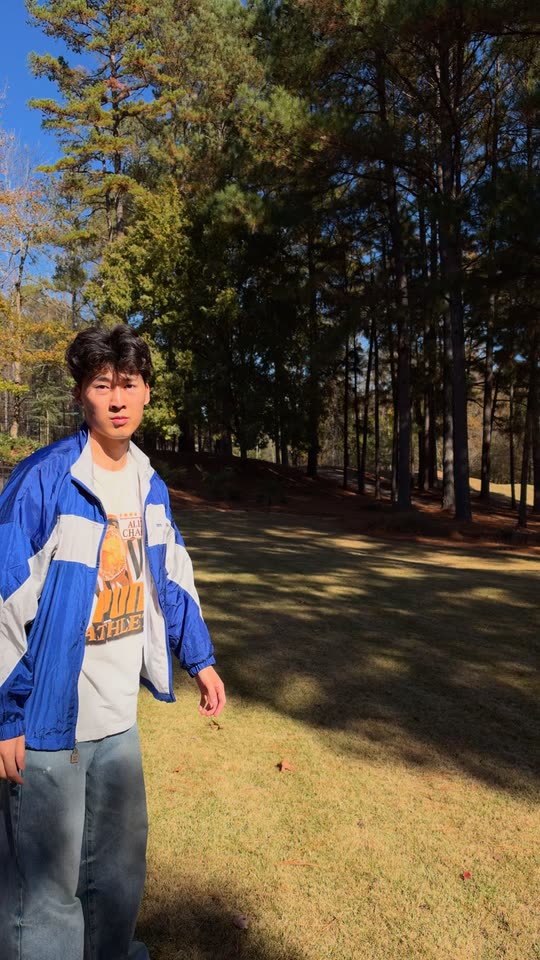
A plate is the empty place with your object sitting in it and nobody in the shot. Generate it as a vertical image, with the light where it would really fall on you. Then take one frame from your take, remove yourself and your shadow, and keep that as the single plate for everything that follows.
A frame from the take 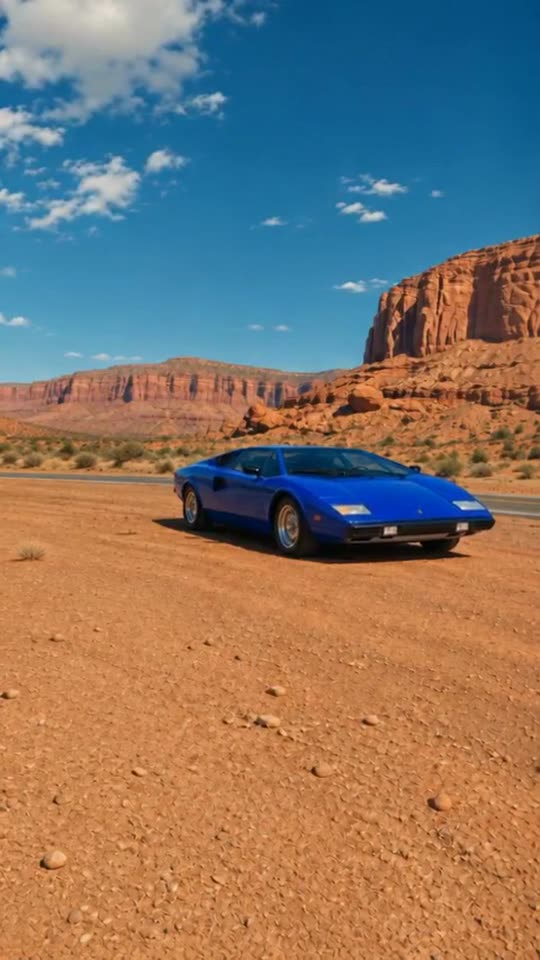
The plate The place and the objectVertical 9:16 photograph, shot on a cinema camera at chest height with a 24mm lens, slightly low angle, real daylight photography, not CGI. Composition: the left third of the frame is open ground (a person will be composited standing there later, do not include any people). A classic 1970s Lamborghini Countach LP400 'periscopio', the original clean wedge with no wing and no flares, sits parked on the ground in the right half of the mid-ground about 8 meters from camera, seen at a front three-quarter angle, its full body visible with plenty of empty sky above it. Hard direct sun from front-right, crisp shadows under the car. Car paint: pale baby blue. Setting: an empty two-lane road pull-off in a red-rock desert canyon in the American Southwest, red sandstone cliffs and mesas, dusty orange dirt, sparse dry sage brush. Warm red-orange palette, complementary to the pale blue car.
Remove yourselfEdit image 1. Remove the young man completely, along with his shadow, and fill that area with the same sunlit dusty orange dirt ground and background that continues naturally behind him. Remove the long thin dark diagonal shadow that runs up from the bottom edge of the frame; the whole foreground is clean, evenly sunlit dirt with small pebbles. Keep everything else exactly the same: the red-rock canyon, sky and clouds, the colour grade, the camera framing, and the deep cobalt blue Lamborghini Countach with its exact position, angle and state. The sun is behind the camera to the right, so the car's shadow falls directly beneath it and slightly back-left, away from the camera. Photorealistic.
Everything you make next starts from this one image. Don't generate a second location.
03
Create your keyframes
Edit your plate twice. In the first, the object floats above where it sat. In the second, it's pulled apart into big real pieces, each moved straight out from the centre, with its insides showing. On my car that was doors out to the sides, roof up, wheels out along their axles and the engine in the middle. Think about how your own object comes apart. Ask for about a dozen pieces. Hundreds of tiny ones look like a drawing.
Parked 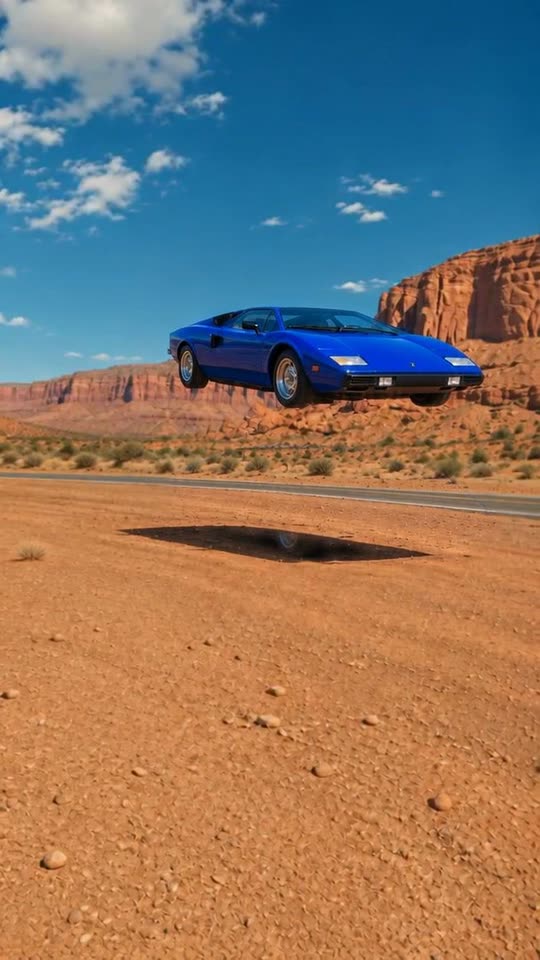
Lifted 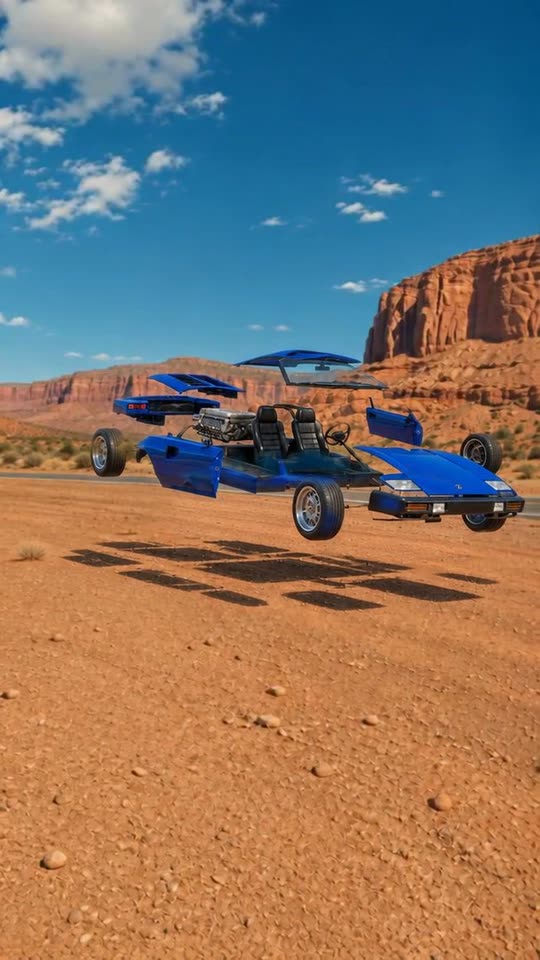
Apart The liftEdit image 1. Change only the deep cobalt blue Lamborghini Countach: lift it straight up so it floats about three meters above the exact spot where it is parked, same angle and orientation, whole, as in image 2. Leave its shadow on the ground directly below where it was parked: a soft, slightly smaller shadow. Keep every other pixel of image 1 exactly identical: same camera framing, same horizon height, same cliffs, road, ground, pebbles, sky and clouds in the same positions. Do not reframe, zoom, crop or regrade. Photorealistic.
The explodeEdit image 1. Change only the deep cobalt blue Lamborghini Countach: it floats about three meters above the exact spot where it is parked, same angle and orientation, and it is pulled apart in mid-air exactly like the car in image 2: doors and side panels moved out to the left and right, roof lifted up, hood forward, engine cover back, each wheel moved straight out along its axle, the seats, steering wheel and a compact V12 visible in the middle, about a dozen big real metal pieces. Scattered soft shadows of the pieces on the ground directly below. Keep every other pixel of image 1 exactly identical: same camera framing, same horizon height, same cliffs, road, ground, pebbles, sky and clouds in the same positions. Do not reframe, zoom, crop or regrade. Photorealistic.
Only the object changes between the three images. If the horizon or the cliffs sit in a different place in any of them, Seedance will slide the background when the object lifts.
04
Generate video with Seedance 2.5
Run Seedance 2.5 in edit mode. Your take is @Video1 and the three images are @Image1 (parked), @Image2 (lifted) and @Image3 (apart). Remove yourself from the video, keep the camera locked, and tell the object what to do at each beat of your performance. Watch your clip slowly and write down the second each gesture lands.
@Video1: your take What Seedance 2.5 generates (no me in it) The runEdit @Video1. Completely remove the young man from @Video1, and his shadow: he is never visible; the scene is empty except for the car. Use his movements in @Video1 only as the timing cue for the car. The camera remains completely static, exactly as in @Video1. Replace the backyard, trees and grass behind him with the red-rock desert canyon roadside from @Image1: dusty orange dirt ground, red sandstone cliffs and mesas, deep cobalt sky with white clouds. Relight and colour grade the whole video to match @Image1: warm golden sun from behind the camera at 45 degrees to the right, teal shadows, faded warm film look. The environment, lighting and composition stay exactly the same for the entire video and never morph or change. Remove the shadow of the camera operator and any long thin pole-like shadow along the bottom of the frame; the bottom is clean, evenly sunlit dirt. Add a deep cobalt blue 1970s Lamborghini Countach, exactly as in @Image1, parked on the dirt in the right half of the frame. The car is moved by an invisible telekinetic force. @Image1, @Image2 and @Image3 are the same locked-off frame with an identical background; only the car differs between them. Every frame of the video uses that exact background and framing. The camera is locked off on a tripod for the whole video: it never pans, tilts, zooms or reframes, and it does not follow the car when the car rises. The background is a fixed plate: the cliffs, horizon, road, ground, sky and clouds stay in exactly the same place, size and shape in every frame, before, during and after the lift; nothing in the background shifts, warps or changes. The car moves on this exact timeline, in sync with the hand gestures in @Video1, though no person is visible: 0-3.2s the car sits completely still, including while his right hand travels down into position. 3.2-3.65s once his right hand is in place, low at his waist, and he starts shaking it with tension, the car shudders and wobbles in sync with that shake, barely lifting a few centimeters. 3.7-3.85s the instant his hand snaps up, the car shoots up very fast, then decelerates and eases into a steady hover about three meters up, directly above where it was parked, as in @Image2, settled by 4.2s. 4.4-4.9s while his second hand comes up and his hands meet near his face, the car keeps hovering, whole. At 5.0s, the instant his hands spread apart, the car disassembles fast in perfect alignment, as in @Image3, completely apart by 5.2s: each exterior piece moves straight outward along its own axis, away from the car's center: left doors and panels to the left, right doors and panels to the right, roof straight up, hood forward, engine cover backward, each wheel straight out along its axle, revealing the seats, steering wheel and a compact V12 that stay in place at the center. About a dozen big pieces. No rotation, no wobble, no distortion, no morphing of the parts. 5.2-6.4s the pieces hover apart while his hands stay up. 6.4-6.6s the instant he presses his palms together, every piece flies straight back along its axis and the car snaps back together whole, still hovering. 7.1-7.35s the instant his hands drop, the force disappears and the car drops fast, straight down under full gravity, landing in exactly the same spot and facing exactly the same direction it was parked in at the start, with a heavy bounce on its suspension and a puff of dust. From 7.4s to the end the car is parked and completely motionless: it never lifts, slides, turns or drives again. Only the car moves. Cinematic, photorealistic, believable physics and seamless VFX integration, no glow, no sparks. Audio: only natural diegetic sound effects: a creak and low metallic hum while the car strains and floats, metal panels sliding and clanking apart and snapping back together, the heavy thud and suspension squeak on landing, light desert wind. No music, no score, no soundtrack.
The timings in my prompt are from my take: lift at 3.7s, apart at 5.0s, together at 6.4s, drop at 7.1s. Use the seconds from yours.
05
Put yourself back in and finish
The result has the object and an empty plate. Lay your take on top, mask yourself out, and match the colour of your layer to the plate. Then speed-ramp the lift and the drop, and add a sound on every move: the strain, the clang, the thud.
Seedance 2.5 output, without me Me masked back in: the finished shot
What goes wrong
The object moves late, after your hands do.
Measure your take frame by frame and write the real seconds into the prompt. Then speed-ramp in your editor. Seedance can still drift by about a second, and the drift changes with the seed more than with the wording.
The background shifts when the object lifts.
Your three images don't share one plate. Rebuild the lift and explode as edits of the same frame.
A thin shadow shows along the bottom of the frame.
It was a shadow from the camera operator in the take. Remove it in the plate edit and name it in the prompt.
The object comes apart as a vertical stack.
Give Seedance the exploded image as @Image3. Describing it in words alone wasn't enough.
Your mask edge looks rough.
You didn't separate enough from the background. Film again in clothes or light that contrast strongly with what's behind you.
You look pasted in.
Your blacks and whites rarely match the plate. Grade your layer by hand until the shadows and highlights sit in the same colour.
Make your own
You can generate everything in this guide in SwiftCut: the plate, the keyframes and the Seedance 2.5 video.
Start creating